

These new rules come at a time when the current disclosure landscape is already saturated. Many companies address the same topics in different communication channels. As an example, aspects of a company’s human capital management and cybersecurity programs are a required component in annual reports on Forms 10-K, but in response to investor and other stakeholder interest, companies also include key aspects of those programs in their proxy statements and ESG reports. Similarly, environmental considerations and climate risk have been a key component of a company’s ESG report, but proxy statements also include statements about climate oversight, goals, and progress. Companies must now conduct a different analysis under the SEC’s climate rules to determine what information to include in their Form 10-K. To add to the confusion, many companies include the same or complementary disclosures on their website.
As of September 2023, Labrador’s benchmarking shows that all but one company in the S&P 250 had published a sustainability report. Many of these companies also disclose ESG information on their website and have an ESG and/or HCM section in their proxy statement.
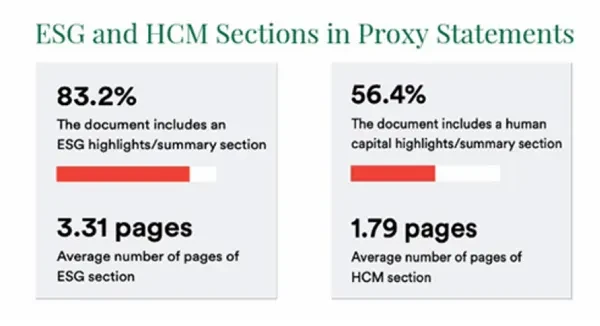
This comes from Labrador’s annual benchmarking exercise of the S&P 250.
With the proliferation of disclosure channels for a single topic, one of the questions that an in-house team contemplates is the depth of coverage for any key topic (beyond what is required for technical compliance) in each of a company’s disclosure mediums. Should disclosures be repeated verbatim or can cross references suffice? Should different aspects of a key topic be covered in each communication with the overarching goal to reduce redundancy?
Adding to the pressure is the increased scrutiny by investors and regulators for consistency and comparability. In 2023, the volume of SEC reviews and comment letters exceeded the volume in any other year since 20181. Some comment letters expressly raise consistency between a company’s SEC filing and ESG report.
- November 2023, Deloitte, On the Radar, SEC Comment Letter Considerations, Including Industry Insights, https://dart.deloitte.com/USDART/home/publications/deloitte/on-the-radar/sec-comment-letter-considerations
Sample SEC Comment Letter:
We note that you provided more expansive disclosure in your corporate social responsibility report (CSR report) than you provided in your SEC filings. Please advise us what consideration you gave to providing the same type of climate-related disclosure in your SEC filings as you provided in your CSR report.
Scrutiny is extending beyond comment letters to SEC enforcement actions. In October 2023, the SEC filed charges against SolarWinds Corp and its Chief Information Security Officer, and alleged that company management was aware of ongoing cybersecurity issues over several years but did not disclose or address them. The SEC pointed to the security statement on SolarWinds’ website, which promoted its cybersecurity practices, in part as the basis for its complaint. This should serve as a renewed lesson for companies that scrutiny extends beyond a company’s filed documents and to executives whose responsibilities do not include preparing SEC filings2. With the recently enacted rules and more on the horizon, we expect the regulatory demands and pressures to continue.
Unified Disclosure Strategy
In the midst of these increased demands, it is imperative that companies take a more proactive approach and holistically review their reports and other public statements side-by-side to ensure disclosures are decision useful, complementary, consistent, and thoughtful. This is especially important for key cross-over topics included in multiple places, like strategy, risk, climate, cybersecurity and other ESG and HCM topics.
While complying with regulations and meeting stakeholder expectations are the paramount objectives, simplifying reports and websites and mitigating risk caused by information overload and perceived discrepancies should also be important considerations. For that reason, companies should develop a holistic disclosure strategy that considers:
- Best practices that take into account investor expectations and peer practices
- Depth, location, and substance of disclosures among annual filings, sustainability reports, proxy statements, websites, and other public statements
- Perceived inconsistencies or discrepancies among communication channels

Labrador is beginning to advise companies on the establishment of a unified approach to their disclosures. Included in this Thought Piece are some preliminary thoughts for companies to consider as they look toward unifying their reporting.
Sustainability Reports
Sustainability reports are a good starting point when considering the development of a unified strategy given their length and complexity. Labrador’s recent benchmarking of 100 companies from the S&P 250 shows an average pagination of 92 pages. 90+ page sustainability reports can be hard to navigate for most readers. Infographics and visuals are key to communicating the company’s messages effectively. Consider these ideas to streamline:
- Include fewer case studies and customer examples in the report, which should primarily focus on strategy, goals, progress against goals, and related challenges and trends for the material topics
- Migrate more case studies and customer examples to a disclosure hub on the company’s website
- Static information that does not relate to performance against goals could be deleted or moved to the website
- Website information linked from a company’s ESG report should be only “one-click” away for easy access
- Use visual cues throughout the report to direct readers where to find more
- Use the same format in each major section which simplifies the messaging, making it more impactful and allowing readers to quickly find information
Just as important as consistent and impactful design and organizational elements, though, is a proactive and thorough analysis of the topics covered in a company’s ESG report. A company should ensure their ESG report, paired with their other public-facing documents provide a consistent and unified message of their material topics. Lay your disclosures on key topics side-by-side and ask these questions:
- Do your disclosures provide a coherent and consistent story across reports and website? Remember the SolarWinds lesson that websites can get as much scrutiny from regulators.
- Are you reviewing it to reduce unnecessary duplication and/or adding cross references, as appropriate?
- Do you discuss how the ESG strategy aligns with the company’s mission, vision, and purpose and how ESG informs strategy, risk-management, and decision-making?
- Are you considering the needs of your internal and external stakeholders (and maybe even polling them) and peer practices to determine the best way to communicate, i.e., whether communicating some details outside of the larger report would be more effective?
Devotes an entire page to listing publicly available policies and resources (with hyper-links).

Highlights a limited number of spotlight stories with design elements so they are easy to locate.

Throughout the report, consistently includes an explanation of “Why it matters” and a callout box of polices and related hyper-links.

Includes a timeline to show that ESG is embedded in how it runs the business.

Ties the company’s purpose, ambition, and strategic priorities to the company’s ESG goals/initiatives.

Specialized Reports
Companies are issuing specialized reports – sometimes annually – on a variety of ESG topics, including human rights, biodiversity and nature, climate risk management and climate action. Several companies also issue Executive Summaries of their full reports and use it with certain stakeholders to convey high-level takeaways. Sometimes companies issue specialized reports to respond to specific regulatory requirements, e.g., gender pay gap reporting in the UK. There is no one size fits all approach to the types of reports a company should issue.
A company should consider what communication methods work best to convey information to its unique stakeholders, and the specialized reports used in its industry or by its peers. If specialized reports are issued, an annual cadence may not be necessary and companies should clearly identify the issuance date and expected update cadence, if known. Care should be taken to reduce unnecessary duplication and increase the use of cross references so readers can quickly understand where to find more.
Walmart takes a unique approach to their ESG reporting. They publish an ESG Highlights report, which provides an overview of their approach to ESG, priorities, and key highlights from the fiscal year. The highlights report is accompanied by a series of issue briefs that cover each of Walmart’s priority issues in depth. Each issue brief notes the date when it was most recently updated and the relevant period covered in that brief.

The highlights report provides a high-level summary of a priority issue and then hyperlinks to an issue brief for more information.

Issues a Sustainability Supplement with its Sustainability Report that includes its framework indices and other data.

Proxy Statements
Any unified disclosure approach should also encompass the company’s proxy statement since investors routinely expect it to have “beyond compliance” disclosures. For example, investors often expect some disclosure about ESG and HCM in a company’s proxy statement since they can be important considerations in vote decisions for directors. At the very least, Labrador recommends that proxy statements include ESG disclosures that:
- Align the ESG strategy with the corporate strategy
- Highlight focus areas and updates on key priorities
- Summarize reporting practices and frameworks
- Identify where readers can find more
- Indicate whether the compensation program includes any ESG metrics
- Discuss the board’s role in ESG oversight and distribution of responsibilities among board, committees, and management
The proxy statement describes the company’s sustainability goals and governance, key frameworks and where to find more.


Forms 10-K and Annual Reports
With the issuance of new SEC climate and cybersecurity rules, the audience for the Form 10-K will increase (especially among those who are used to reading visual sustainability reports). Although Forms 10-Khave historically been text heavy and dense, more companies are using font, color, headings, infographics, and other design features to enhance their effectiveness and readability.
As part of a unified disclosure strategy, Labrador recommends a more visual Form 10-K that leverages and is visually consistent with the company’s other disclosure materials. This can enhance engagement by investors.
Considerations for the Form 10-K include:
- In the Business section, can the company lean into infographics used in investor presentations, proxy statements, ESG reports, and websites to allow for consistency of presentation? This may be particularly useful for information related to business overviews, segment highlights, strategy, key business developments, and human capital management disclosures.
- Can the Executive Officer biographies be drafted and formatted consistent with the director biographies in the proxy statement?
- Can an infographic be used at the beginning of the Risk Factors section to effectively summarize risks?
- In MD&A, can bar charts, callout boxes or other infographics be used to highlight key financial information?
- Could a glossary of terms and abbreviations add to the effectiveness of the disclosure?
For more ideas, see our latest Thought Piece, entitled Improve the Readability and Transparency of Your Form 10-K Through Information Design, https://www.labrador-company.com/our-thoughts/.
CEO letters in annual reports should also be considered as it is an important tool in communicating business developments over the last year.
Uses iconography to break up dense text and highlight key information.

Provides a more visual view of executive officers in their Form 10-K.

Uses infographics in the MD&A to make information more easily digestible.

Websites and Other Communication Tools
As noted above, some companies are migrating to a reporting format in which sustainability reports focus on public ESG commitments and performance, with other details included on a dedicated webpage. Companies should proactively review their ESG reports holistically and analyze which disclosures relate to the company’s ESG strategy, goals, and progress on prioritized topics. If information does not relate to goals and progress on priority topics, consider whether that information can be deleted entirely or moved elsewhere.
While websites are easier to update and less time-constrained in their preparation, they still require attention to detail to make sure disclosures are accurate and complete. Websites should be easy to navigate and updated to correct stale information. Considerations include:
- Can case studies, customer examples, lists of awards/recognitions and memberships/associations, and other text heavy information be included on the website?
- Can quotes from business leaders be added to provide necessary context and impact?
- Can the company provide one consolidated view of key reports over the last several years in one place?
- Can the ESG metrics be placed prominently on the website so they are easy to find?
Companies are also using other communication tools to deliver key messages. This can include the use of social media, videos, sustainability blogs or other periodic tools like a newsletter. Like specialized reports, there is no one size fits all approach, and companies should engage with their key stakeholders and understand the tools used in their industry or by their peers in developing a unified strategy.
Includes links to the report, performance index and disclosure hub on the top of the page. Their disclosure hub contains an effective index of their reports over the last five years. Their performance index is prominently displayed and includes data over the last five years.


Learn More
At Labrador, we follow and understand evolutions in corporate communications and transform our knowledge into opportunities for our clients. Our award-winning experience helps companies engage with their stakeholders, including employees, investors, analysts, and others, through effective corporate disclosure materials.
Through our advisory and design services, Labrador can provide bespoke strategy recommendations and create custom infographics. To learn more, contact us at contact-us@labrador-company.com.