
To instill stakeholder trust, we suggest that companies changing their sustainability goals or targets increase transparency around the what, how and why of their new approaches.
Goals versus targets
While goals are broad and aspirational statements, often qualitative in nature, targets are quantitative and measurable benchmarks with baseline and deadline years. Our recommendations on transparency around why goals or targets are being changed, replaced or eliminated are the same for both.
Achievement of Existing and Setting New Goals or Targets
Some companies use progress bars, callout boxes and other design elements to discuss the achievement of a sustainability goal or target. In addition, they often provide context on how they intend to make further progress post achievement, especially if the achieved goal or target was part of meeting a broader long-term commitment like net-zero greenhouse gas (GHG) emissions or zero waste.
For example, Target met two of its 2025 goals early: sourcing 60% of the electricity for company operations from renewable sources and reducing operational food waste by 50% across stores, supply chain facilities and headquarters from a 2017 baseline year as part of their plan to achieve zero waste to landfill in their U.S. operations by 2030.

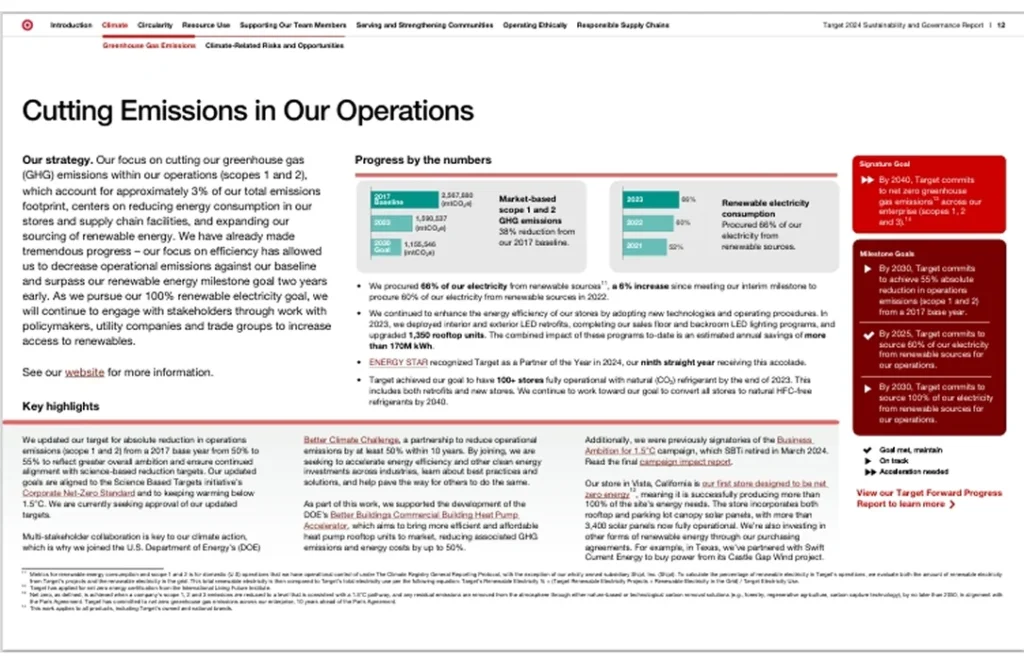
Target used progress bars and callout boxes with icons in its 2024 Sustainability and Governance Report to explain which of their sustainability-related goals were met and being maintained, on track to be met, or in need of acceleration to meet their timeline.
New Circumstances and Eliminating Goals or Targets
More companies are becoming transparent about the challenges they face in meeting their sustainability goals or targets, including how they are adapting.
For example, in the introduction to Air Products’ 2025 Sustainability Report, the company expressly states that the report does not include an update on its environmental goal performance because the company is transitioning to a new GHG emissions reporting approach to align with developing global regulatory and reporting requirements. As a result, they explained, their 2026 report will include a new emissions reporting boundary aligned with the company’s financial reporting, disclosure of all the company’s material Scope 3 emissions and reporting on emissions from facilities previously not included in their prior emissions inventory boundary—all improvements in their climate reporting.

Air Products transparently explains in its 2025 Sustainability Report how the company is improving its climate disclosures going forward.
Similarly, Lululemon discusses in its Impact Report 2024 how it has met, updated or is eliminating (and in some cases replacing) its sustainability goals and why.


For each of its sustainability topics in its Impact Agenda 2030 report, Lululemon discusses its overall approach, progress against goals, what they are doing to meet their goals and what’s next as they maintain, update or eliminate goals.
A growing number of companies are scaling back or eliminating their GHG emissions reduction targets, including pushing back timelines for achieving net zero by 5 to 10 years or eliminating their targets altogether. A chart published by Generation Investment LLP¹ shows a trend of delaying net-zero target dates set post 2022, making them less ambitious or, as many companies explain, more realistic.

Generation Investment LLP’s calculations using Net Zero Tracker for the world’s largest 2000 companies
Similar adjustments to target dates are evident around targets related to circularity and zero waste. Companies like Coca-Cola, Walmart, Nestlé, PepsiCo, Mars, and others have shifted from targets focused on reducing the use of virgin plastic derived from non-renewable sources and increasing use of refillable and returnable packaging by 2025 or 2030 to commitments focused on the collection of recyclables and the use of recycled materials. Several of these companies have explained that, while they have made progress, there are “inherent systemic challenges” that have made it difficult for them to meet their initial ambitions.²
Why is scaling back happening?
Some companies may have set their goals or targets in response to external stakeholder pressures before aligning internal resources to determine their feasibility. In addition, local, state, national and foreign regulations, incentives, tax credits and other governmental “carrots and sticks”—along with advancements in affordable and scalable technology—in many cases haven’t kept pace with initial company ambitions. The political and economic instability of the last five years—from supply chain disruptions to rising material costs to political scrutiny of environmental, social and governance (ESG) commitments and programs, including industry coalitions around climate—has made setting realistic plans to meet goals and targets that much harder.³
As companies deal with the realization that in some cases progress is misaligned with expected time horizons, they are faced with the challenge of communicating this reality to their investors and other stakeholders. While greenhushing (purposely not disclosing sustainability-related information) may be growing as a temporary solution, we recommend directly addressing challenges, roadblocks, and ongoing learnings. Transparency can demonstrate resilience, instill stakeholder trust and lead to long-term value creation. Greenhushing also can result in legal liability.
The Special Case of DEI
A growing number of U.S. companies have also scaled back or eliminated other sustainability-related goals around diversity, equity and inclusion (DEI). See Labrador’s comprehensive thought piece on this topic here.
Best Practices to Consider
Be transparent about what has changed and why
Using a materiality lens, we suggest thoughtfully thinking through not only the disclosures around changed sustainability goals and targets but also their timing and location—from voluntary or regulatory reports to websites and social media. Consider discussing the original goal or target, the reasons for specific changes, and any related impacts on the business or its other sustainability goals or targets. Keep in mind how changes in goals, especially their elimination without replacement, may be perceived by investors and other stakeholders. Companies may also want to think through the timing and messaging of communicating changes in sustainability goals and targets and the timing of earnings calls, investor days or regulatory filings.
Other details to consider disclosing:
- How lessons learned are applied to new sustainability initiatives where the company can have the most cost-effective impact.
- How updated or new goals or targets better align with overall business strategy, industry best practices, regulatory requirements, stakeholder input, or the latest available technologies.
- What data recalculations, methodological improvements, baseline year updates, and other changes were necessary to align with the changed target.
For example, in its FY2025 ESG Report Walmart describes in detail the challenges it faces in meeting its packaging goals and commitments.

Walmart shares examples of its progress indicators, actions and challenges to help explain how the company is addressing obstacles it faces in meeting its packaging-related sustainability goals.
Consider charts and infographics to explain complex changes
Sometimes an infographic or chart is the most succinct way to explain changing goals or targets as opposed to pages of narrative. We recommend developing clear disclosures that are consistent with the company’s core values and use as little jargon as needed to align with topic or industry best practices.
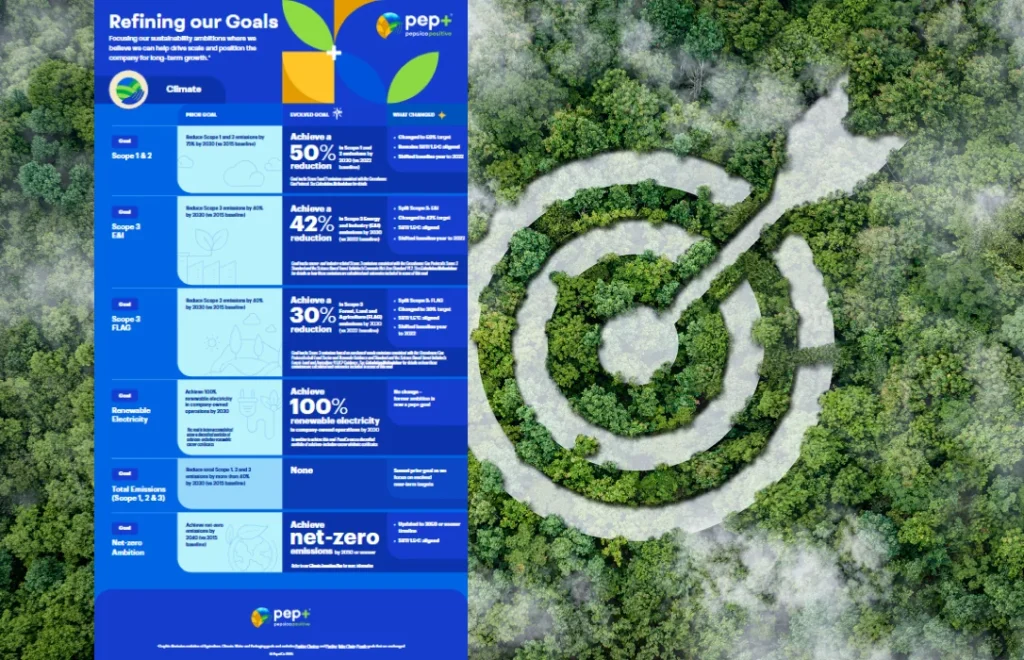
One example is PepsiCo’s Positive Goal Evolution Graphic, which showcases how its suite of targets are evolving as they work towards net-zero GHG emissions by 2050 or sooner. This net-zero infographic is accompanied by similar infographics explaining the company’s other sustainability goals in regenerative agriculture, water, packaging, sustainable sourcing and more. Also included are links to the company’s climate transition plan and other documents for more detailed information.
Similarly, in its 2022 Sustainability Report Crocs dedicated a page to why it changed its net-zero target deadline from 2030 to 2040, explaining:
“We’ve learned a lot in the past year. In 2021, we made a public commitment to be Net Zero by 2030. We stated this goal knowing it was ambitious, necessary, and frankly, neither vast nor fast enough—a common reality for most brands (and not even just those in the footwear and apparel industry)… We have adjusted course to create the timeline needed to deliver on our sustainability ambitions, while continuing to support our growth ambitions. Our new enterprise goal is to be Net Zero by 2040. This is still an ambitious goal when accounting for the realities of our business and recognition of both brands, but it’s a more realistic and credible goal given that our total emissions are significant, our growth projections are aggressive, and our footprint looks quite different today than when we set our initial goal.”

Croc’s Journey to Net Zero (by 2040) infographic shows how the company is “full steam ahead on building a pipeline of reduction initiatives, as well as assessing, modeling, and determining the potential scale and impact of short and long-term investments.”
Double down on communicating progress
Changing goals or targets brings increased responsibility to clearly communicate how progress going forward will be measured, monitored, and communicated. Communicating how lessons learned have been translated into action can signal accountability, especially if such communication comes from a company leader.
For example, Microsoft Chief Sustainability Officer (CSO) Melanie Nakagawa posted a progress note on the company’s website explaining the challenges the company faces in meeting its climate commitments set in 2020:
“The world is not on track to meet critical climate goals and we see many of these challenges reflected in our own journey. In 2020, Microsoft leaders referred to our sustainability goals as a “moonshot,” and nearly five years later, we have had to acknowledge that the moon has gotten further away. However, the force creating this distance from our goals in the short term is the same one that will help us build a bigger, faster, and more powerful rocket to reach them in the long term: artificial intelligence (AI). This is not hyperbole. Already, we are seeing AI make a positive impact on the planet, and in the coming years, this technology will begin to rapidly accelerate climate solutions at a scale we’ve not yet seen… [We] need to run our sustainability initiatives like we run the rest of our business: ensuring that our focus is on the highest-impact interventions that truly move the needle when it comes to planetary impact.”

Microsoft Chief Sustainability Officer (CSO) Melanie Nakagawa’s 2025 climate progress note included a link to its 2023 AI and Sustainability Playbook, which Nakagawa explains will guide the company in “unlocking AI’s full transformative potential for accelerating sustainability progress.”
Consider third-party review
To demonstrate that changed environmental goals and targets align with leading international practices (including climate science), consider obtaining third-party certification by working with groups like SBTi (Science-based Targets Initiative), SBTN (Science-based Targets Network), the International Organization for Standardization (ISO)’s Net Zero Standard, or others. Outside certification can provide external, third-party review that new goals and targets still put the company on a credible path.
Special considerations for regulatory disclosures
It is important to communicate consistently, not only in annual sustainability reports but also in related disclosures on websites, in surveys and questionnaires like CDP, and elsewhere about any changes made to sustainability goals and targets. Consistency will be increasingly important as more sustainability disclosures move from voluntary reports and questionnaires to required disclosures like those under California’s SB 261 and SB 253 or the CSRD.
The increase in regulatory disclosures has led to a related shift in corporate management and oversight of sustainability. More centralized in-house teams that oversee sustainability reporting controls, audit trails and external assurance—similar to those for financial reporting—contribute to improving consistency, efficiency and risk management. Such rigor should help companies improve their sustainability reporting going forward, including around changing sustainability goals and targets. We also suggest working with internal and external legal departments to refresh forward looking, cautionary, safe harbor and other disclaimer language in reports and on websites.
Looking Ahead
Consistent, evidence-based disclosures that align with a company’s core values and directly tie to business strategy are more important than ever in today’s politically and economically uncertain landscape. Investors, customers, employees and other stakeholders still expect companies to meet their stated sustainability commitments and communicate regular progress. Between the risky extremes of “greenwashing” and “greenhushing” lie transparent disclosures that accurately tell a company’s sustainability story while mitigating unnecessary risk and scrutiny. As companies continue to evolve their sustainability goals and targets, finding this strategic balance is a best practice from which all companies can learn and improve.
- Generation Investment LLP. (May 14, 2025). “Are Companies Backsliding on Sustainability?”
- Darley, James. (May 23, 2025). “Why Walmart, Nestle, Mars & More Have Left US Plastics Pact.” Sustainability Magazine.
- Hawkins, Neil. and Cooper, Kelly. (September 23, 2025). “Are Companies Actually Scaling Back Their Climate Commitments?” Harvard Business Review.
- Wrobel, Miriam and Spryshak, Jackie. (November 12, 2025.) “How Companies Are Reframing Climate Communication in 2025.” Harvard Law School Forum on Corporate Governance.