
The companies that offered more information were smart. Glass Lewis’s 2024 Benchmark Policy Guidelines say that “[i]n the absence of any evidence in the disclosure that the board is actively engaging shareholders on [their compensation concerns] and responding accordingly, we may recommend holding compensation committee members accountable.” ISS’s 2024 Proxy Voting Guidelines also call for more disclosure—about engagement efforts, specific shareholder concerns, and responsive actions taken—when a company’s say-on-pay proposal earned less than 70% support the previous year. Although there is no way to prove causation, Equilar’s study showed that 85% of the reviewed companies that supplemented their disclosure after a bad SOP vote had a successful vote the following year.
In the examples below, the companies offer thorough discussions that include how many investors they contacted and spoke with, how the Board participated in or learned about those engagements, specific feedback they received, and specific changes they made to their compensation programs. Say-on-pay results improved for the companies we feature here, with some doubling their support from the prior year.
ServiceNow
ServiceNow’s 2024 proxy tackled its response to disappointing say-on-pay results head-on. The proxy summary (at pages 5-6) includes one page about the company’s shareholder engagement generally, and a second page that reviews specific shareholder concerns about the compensation program. These pages, from the beginning of the CD&A provide additional detail regarding shareholder feedback, and explain exactly how and why the compensation committee adjusted the incentive compensation plans. A graph a few pages later shows the significant increase in shareholder value during the CEO’s four-year tenure to support the argument that his compensation is aligned with performance.


Equifax
Equifax starts its CD&A executive summary with an “at-a-glance” engagement timeline and follows with a detailed accounting of what happened at each step in the engagement process and a description of shareholder concerns and the company’s responses.


AIG
The Governance section of the AIG proxy (at pages 34-35) has a general engagement discussion. The excerpt below, from the middle of the CD&A, is specific to compensation matters. It presents some of the same information as the general engagement discussion does, but in a different way that conveys key information without undue repetition.

Pitney Bowes
Pitney Bowes included its shareholder feedback disclosure early in the CD&A. It provides a possible reason for their low SOP vote (a concurrent proxy contest), but also gives detailed information about investor concerns and the company’s responses.


Changes to the Compensation Program
Companies periodically revise their executive compensation programs for reasons that are unrelated to the SOP vote. It is important to explain those changes, the reasons they were implemented, and, if relevant, how they are being phased in, so shareholders can assess the new compensation program and the soundness of the compensation committee’s decisions. A specific header that flags program changes helps readers find this key information.
International Paper
International Paper explains the compensation committee’s standard process for reviewing the compensation program and then outlines the most recent plan changes and their effective dates.

Starbucks
Starbucks explains why its annual incentive plan was adjusted and provides a graphic that makes it easy to see the differences between the 2023 and 2024 plans.

PVH
PVH offers the reasons for recent plan design changes, linking some directly to company strategy. PVH also adds small graphics to show the updated performance metrics and weights.

Leidos
Leidos provides side-by-side comparisons of their 2023 and 2024 short- and long-term incentive plans, with graphics to illustrate how a newly-added modifier will work.


Netflix
The graphic below, which follows several pages of discussion about Netflix’s shareholder engagement efforts and a note from the Chair of the Compensation Committee, makes it easy to see how the executive compensation program has evolved to rely more heavily on performance metrics and long-term equity awards. The next two pages of the CD&A add more detail and context for the most recent changes.

Mondelez
Companies that have assessed their compensation programs and determined that no changes are necessary should consider mentioning that fact so readers don’t worry that they are missing something.

Leadership Transitions and Related Compensation Decisions
It is the rare company that has the same five NEOs year after year after year. People retire, move on (voluntarily or otherwise), and may experience health problems. It helps to be upfront about these situations, and the beginning of the CD&A is a logical place to address them. Some transitions, such as a new CEO or a complete restructuring of the executive team, also may warrant a mention earlier in the proxy.
Intuit
Intuit’s leadership changes, which appear to have been amicable and part of ordinary course succession planning, were also flagged in a small callout box in the proxy summary. Compensation decisions for the departing NEOs were discussed in the same places in the CD&A as decisions for the remaining NEOs.


Kraft Heinz
Kraft Heinz’s planned CEO succession is addressed at the beginning of the CD&A, and also is discussed in a “Company Overview” section at the beginning of the proxy. Compensation for the new CEO is discussed in the same place within the CD&A as compensation for the other NEOs, but there is an additional section later in the document that explains how his compensation package differs from the compensation provided to his predecessor.


Cushman & Wakefield
Cushman & Wakefield’s planned CEO succession, internal promotion, and new executive hire are discussed at the beginning of the CD&A. Compensation for the retiring CEO and all of the new NEOs is discussed within the CD&A in the same place and manner as compensation for the continuing NEOs.

CVS
CVS discussed its two ordinary course leadership transitions and one departure at the very beginning of the CD&A. Compensation for the two new NEOs is covered in the same place in the CD&A as compensation for the continuing NEOs. There is an additional section that explains the contractual arrangements and one-time awards provided to the new NEOs.

Pitney Bowes
To address an involuntary termination of its chief executive officer, Pitney Bowes used the beginning of the CD&A to introduce the new CEO and explain his compensation, and also to disclose the severance pay for the former CEO.


AIG
AIG addressed transitions due to the illness and then death of the CFO, as well as the termination of an interim CFO, at the start of the CD&A.

Southern Company
An early section of the CD&A includes a flowchart to show how Southern Company implemented several planned executive transitions, including at the CEO level. This is followed by an overview of the compensation decisions for the new and departing CEOs, a summary of the company’s performance against key metrics, and two pages that demonstrate how CEO compensation is aligned with financial and environmental performance.


Letters from the Compensation Committee
Based on Labrador’s recent survey of 100 companies (a subset of the S&P 250 and cross-section of industries), approximately 17% included a compensation committee letter in their most recent proxies. Although it is not common practice, including a letter from the compensation committee may provide a good vehicle for previewing the compensation program, especially if there were recent changes, and for discussing leadership transitions and any special bonuses or awards granted. In the year following a disappointing SOP vote, the letter can delve into the committee’s engagement efforts and approach to feedback.
Healthpeak
Healthpeak’s Compensation and Human Capital Committee used its letter to highlight the objectives of the compensation program and the changes in the NEOs’ compensation amounts from the prior year, as well as to summarize results under the long-and short-term incentive plans.

Johnson & Johnson
The letter from J&J’s Compensation & Benefits Committee focuses on recent changes in the company’s business and on the committee’s process for reviewing the compensation program and results for the year. The letter also notes the payout levels for the long- and short-term incentive programs.

CSX
The letter from CSX’s Compensation and Talent Management Committee starts by emphasizing the committee’s responsiveness to shareholders and to employees, and then discusses recent changes to the compensation program and the reasons for those changes. The letter then shifts to the committee’s responsibility for human capital management, and reviews the company’s successes under the leadership of the recently appointed CEO.


Intel
Intel’s Talent & Compensation Committee used its letter to explain how its compensation decisions—including salary and bonus reductions for executives—reflected a difficult economic environment and served the company’s cost-reduction goals.


Southern Company
The Southern Company’s Compensation Committee makes a practice of including a letter at the beginning of the CD&A each year. The most recent letter focused on the goals of the compensation program and the company’s successful leadership transitions, and explained how the committee gathered and responded to shareholder feedback.


Definitions of Pay that Differ from the Summary Compensation Table
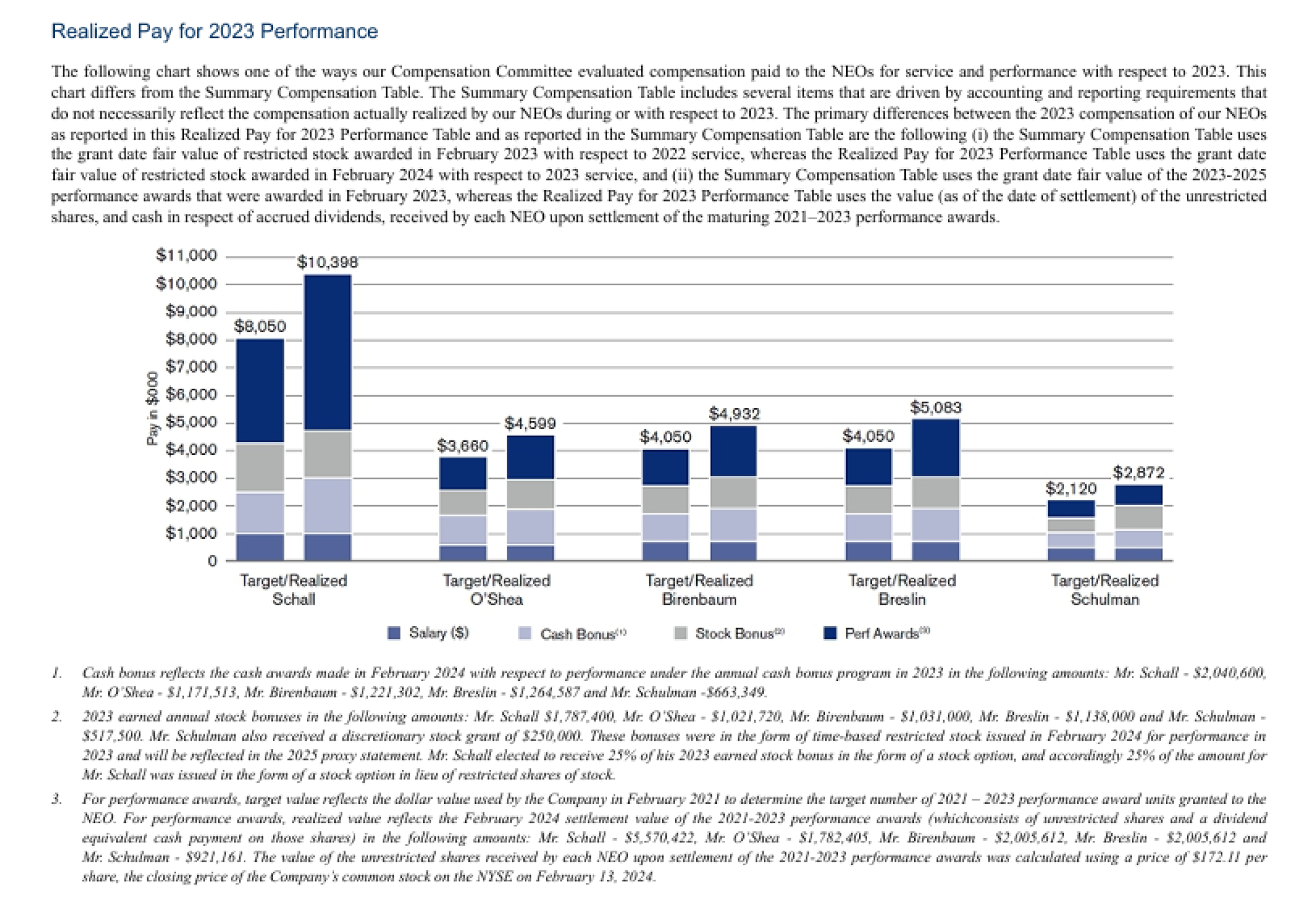
CD&A’s can be confusing. Companies talk about the “target” compensation they awarded and the “actual” compensation their NEOs received, or about “realizable” and “realized” compensation, and usually the numbers provided with that disclosure differ from the numbers in the Summary Compensation Table. A section that explains terms and calculations can help readers understand how the compensation committee approaches its decisions.
Avalon Bay
For each NEO, Avalon Bay provides a bar graph showing target pay and realized pay, and explains the relevance of these calculations to the compensation committee’s evaluation of pay and performance alignment. The narrative that precedes the graphics explains why the realized pay numbers may vary from the numbers that appear in the Summary Compensation Table.
Raytheon
Raytheon includes a short explainer to help readers understand why the CD&A numbers for the NEOs’ “total direct compensation” vary from the numbers in the Summary Compensation Table. This designed callout draws the readers’ attention to how the compensation committee views long-term incentive awards. In particular, while SEC rules require the Summary Compensation Table to include the value of long-term awards in the year they are granted, Raytheon’s Human Capital & Compensation Committee considers these grants, which are made at the start of the fiscal year, to be part of the prior year’s compensation since award values are based on the committee’s assessment of that year’s performance.

Cognizant
Cognizant provides a comprehensive explanation of the terms “target direct compensation,” “SEC compensation” (meaning the amounts reported in the Summary Compensation Table), and “realized compensation,” and then explains how those terms apply to each element of the NEOs’ pay. Finally, for each NEO, the company describes, and shows in a graph, the three types of compensation.


Oceanfirst
Oceanfirst uses text and a bar graph to explain why the CEO’s realizable pay for the past three years, taking into account the current value of his equity awards, is less than his target pay. The disclosure also states that the Compensation Committee regularly reviews realizable pay (base salary, bonus, and equity awards) to determine whether the compensation program is working as intended.

Performance Tracking for In-Flight Awards
When investors are evaluating a company’s most recent long-term equity awards, they may wonder how many of the performance-based equity awards granted in previous years are on track to pay out. According to Labrador’s recent survey of the top 250 companies in the S&P 500, less than 25% provide this information in their proxy statements. Even if the disclosure only gives directional guidance on how awards may pay out, the information may help readers understand the company’s long-term incentive program.
Healthpeak
Healthpeak shows the results of the most recently completed performance period and gives a general sense of how the two performance periods in progress are tracking.

Welltower
Welltower shows four years of completed LTI cycles and the two performance periods that are in progress. Readers can see payout trends and assess the likelihood that in-flight awards will vest.

Cognizant
Cognizant provides very specific results for the completed performance periods and reminds readers what the goals were for those years, but does not forecast expectations about the remainder of the performance cycle. This is a useful strategy for companies that are wary about suggesting that results for an incomplete multi-year period are tracking a particular way.

Starbucks
Starbucks is very specific about the goals and results for the completed years
without appearing to make any predictions about performance periods in progress.

Equifax
Equifax’s color-coded bar graphs show generally the status of the in-progress and most recently completed performance periods.
The company also provides graphs showing how the CEO’s awards specifically are tracking.
