
At Labrador, we follow and understand evolutions in corporate communications and transform our knowledge into opportunities for our clients. Our award-winning experience helps companies engage with their stakeholders, including employees, investors, analysts, and others, through effective corporate disclosure materials.
In this Thought Piece, we will discuss ways to structure and present your Code of Conduct so that it is relevant and influential and, in turn, more effectively supports your compliance program and improves your overall messaging.
In May 2025, we added recommendations for periodic review of your Code of Conduct and considerations for addressing DEI-related content.
Deeper Dive
Like many compliance documents, Codes of Conduct have moved beyond simple one-to-two page lists of policy statements drafted to strictly meet the bare minimum requirements for which they were originally intended. They have now become part of an overall investor suite of documents available on the company’s website. As a result, Codes of Conduct are now written for a wide-ranging audience that goes well beyond the company’s employees.
In addition to its internal purpose, the Code of Conduct is a useful tool for investors, prospective employees, potential business partners, government agencies, and other stakeholders to take a look into a company’s culture to learn more about how it promotes values, drives ethical behaviors, and operates with purpose.
Further, third-party organizations who provide ratings and rankings related to a company’s environmental, social, and governance programs will evaluate a company’s Code of Conduct across a number of criteria to arrive at their determination of a company’s adherence to good governance and compliance practices and its commitment to a variety of ESG factors.
Looking at Codes of Conduct with an eye towards the five pillars of transparency will help you transform your Code of Conduct into a modern document that better engages employees and drives behavior:
1. Accessibility
Readers can quickly find pertinent information in a document and information is presented in a manner that is easy to digest.
4. Clarity
Writing is in clear, plain language so that disclosures are immediately understood by the reader.
2. Precision
The disclosure prioritizes thoughtful reporting and includes critical information beyond requirements of compliance that helps readers understand the company.
5. Comparability
Information is summarized appropriately and presented in a way that facilitates comparisons across companies and against readers’ own guidelines, criteria and expectations.
3. Availability
Readers can easily find the document(s) they want in the format and language they need.
What does a good and effective Code of Conduct look like?
- The Code of Conduct should be both an impactful call to ethical behaviors and an inspiring user experience to ensure “readability” created by visually engaging design, an easy to reference structure, and clear, inclusive language.
- The document should be comprehensive, explaining the purpose of the Code and who it applies to and detailing expectations around various themes, such as: anti-corruption and ethical business practices; fair labor, employment practices and work environment; employee behavior expectations; confidentiality, information security and protection of intellectual property.
- A Table of Contents should appear at the outset to help readers see what is covered by the Code and easily navigate to specific topics.
- It should begin with a letter from the Chief Executive Officer or the Chief Compliance Officer of the company setting the “Tone from the Top”.
- The document should include a section outlining reporting procedures and making clear that the company prohibits retaliation against those that report concerns.
- Beyond content, effective Codes of Conduct benefit from design to support the substance of the Code – the goal is to create a document that employees will read, understand, and remember, so that it is considered a useful resource when they have questions.
- To that end, in addition to being visually appealing, design allows for the use of infographics throughout the Code to make important information more digestible and to provide information that goes well beyond the letter of the law – through decision trees, Q&A or examples, and other ways to highlight information such as links to other policies. These aspects create interactivity and engagement with the Code that makes it more useful to employees and ideally results in better compliance outcomes.

When should a Code of Conduct be updated?
The Code of Conduct serves as the foundation of the company’s compliance program and is a crucial tool for risk management and prevention. It should adapt to the evolving risks and business environment of the company.
Legal requirements, stakeholder expectations, and workplace dynamics change continuously, so the Code of Conduct must be reviewed and updated regularly to reflect these changes. While an annual review is advisable, it does not necessarily mean that the Code of Conduct should be updated each year. When it comes to ethics and compliance, stability and clarity are vital for ensuring that employees fully understand and embrace the Code.
78%
of companies update their Codes every 1 to 3 years
6 questions to determine if you should update your Code of conduct:
1. Have there been any changes in the organization, internal policies, or processes (e.g., merger and acquisition, leadership change, etc.)?
2. Are there any new risks that have emerged (e.g., exploring new markets, introducing new products, utilizing new tools, changes in the risk environment, or stakeholder feedback)?
3. Have there been significant changes in the company’s business environment (e.g., new legal requirements, public policy changes, or shifts in stakeholder expectations)?
4. Does the Code of Conduct align with the current culture, values and identity of the company?
5. Is it consistent with the company’s other publications (e.g., Annual report, Sustainability Report and related policies, Proxy Statement)?
7. Can the readability and accessibility of the Code be improved, and is this a suitable time to do so (considering budget and resources)?
YES
It’s important to take the time to update your Code this year.
NO
There may not be a need to update it just yet. You can go through this process again next year.
Remember, Codes of conduct should reflect the current environment and culture of a company, so they should be updated every couple of years.
Focus on consistent messaging of DEI content
Companies currently navigate a complex and uncertain landscape balancing growing requirements from non-US regulatory regimes with mixed expectations of stakeholders and anti-DEI sentiment (and legal risk).
What companies should keep in mind:
- Consistency across company publications (including compliance documents, annual reports, sustainability reports and proxy statements) is essential. This means the language and the approach should be reviewed to match other disclosures.
- Reflecting recent widespread changes to annual reports and proxy statements, many companies are removing references to diversity or DEI and shifting language to inclusion and/or belonging.
- In addition to language transitions, components of previous DEI-specific sections may be removed and integrated into other human capital management sections.
- The focus has shifted to overall corporate culture and fairness, as well as workforce and talent development, employee engagement, and anti-discrimination.
- Companies should anchor their discussions on how policies related to DEI support overall corporate strategy and drive long-term success (for example, talent retention).
- Stakeholders including customers, employees, certain investors, and even suppliers may question a company’s reversal of its commitments, leading to loss of trust in the company and its disclosures.
Examples of changes to Codes of Conduct (May 2025)
Retail
- Revised title to “Inclusion and Belonging” (from DEI)
- Removed references to diversity and emphasized how inclusion and belonging serve the company’s long-term success
- Removed link towards Racial Profiling Policy
- Continued to address equal treatment in HR processes, emphasizing the importance of anti-discrimination and culture of kindness and openness
- Continued to address the topic alongside anti-discrimination
Software
- Moved HCM-related section to the end of the document (along with other significant evolution in the document structure and topics)
- Revised title to emphasize inclusion and removed references to diversity
- Abbreviated the sub-section from two to one page
- Shifted language on topic from commitment to strategic asset
Removed links to DEI report and website
Kept the guidelines focused on fighting discrimination and harassment
Healthcare
- Revised title to “Workplace culture” (from DEI)
- Continued to address the topic in a very short subsection
- Revised language to emphasize inclusion rather than diversity
Benchmarking
With focus on ESG in recent years, and ESG reporting frameworks calling for disclosure of ethical practices, it follows that codes of conduct are starting to be more consistently reviewed and updated.
63%
have a document dated and produced or updated within the last two years
Most companies include a letter from the CEO explaining why the policies and practices in the code of conduct are important to company culture and business, as well as setting expectations for strict compliance. This letter is often found at the beginning of the document, along with an overview of cultural values.
80%
include a letter signed by the CEO
51%
of the letters mention the importance 51% of (i) ethics, compliance, and integrity, (ii) following the code, and (iii) reporting a concern
74%
present company values at the beginning of the document
Encouraging reporting of ethical concerns requires practical guidance and instructions. Fact patterns with guidance on how to manage the situation and Q&A formats are helpful. Codes of conduct should also have visual cues to easily locate key information and understand how to report a concern.
31%
include decision-making tree graphic
8%
include a graphic depicting the reporting procedure
Disclosure Examples
In the following pages, we include examples through the following lenses:
Anatomy of a Code of Conduct
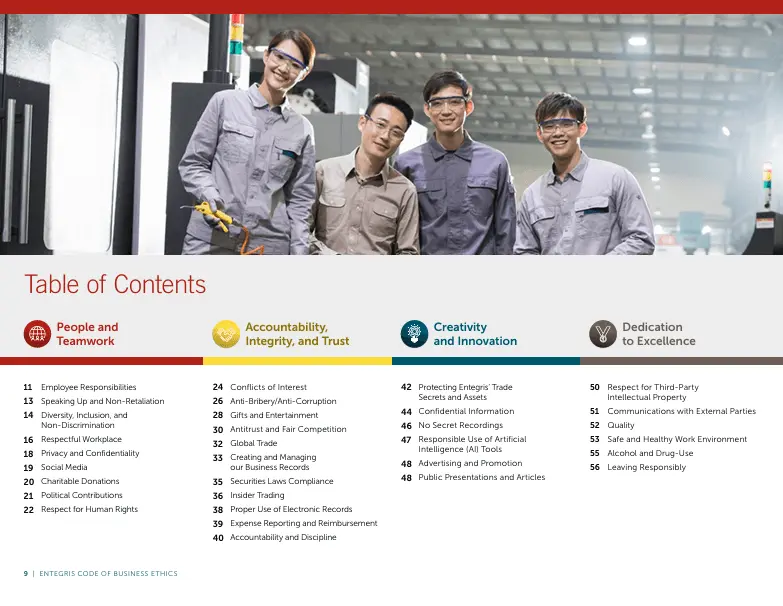
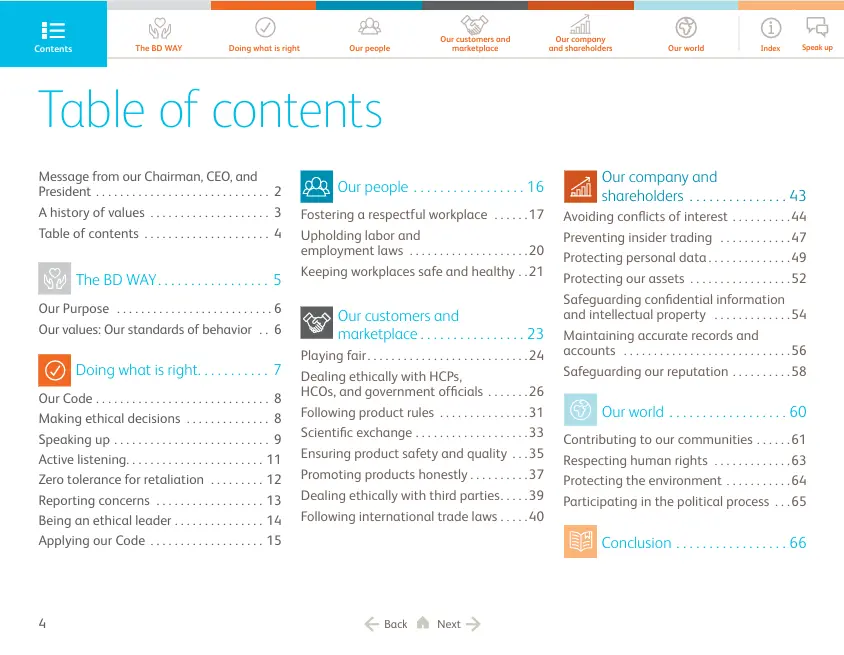
Table of Contents
The Table of Contents both demonstrates the breadth of topics covered in a modern Code of Conduct and aids the reader in navigating the document to find information.

Conviction, Ownership and “Tone From the Top”
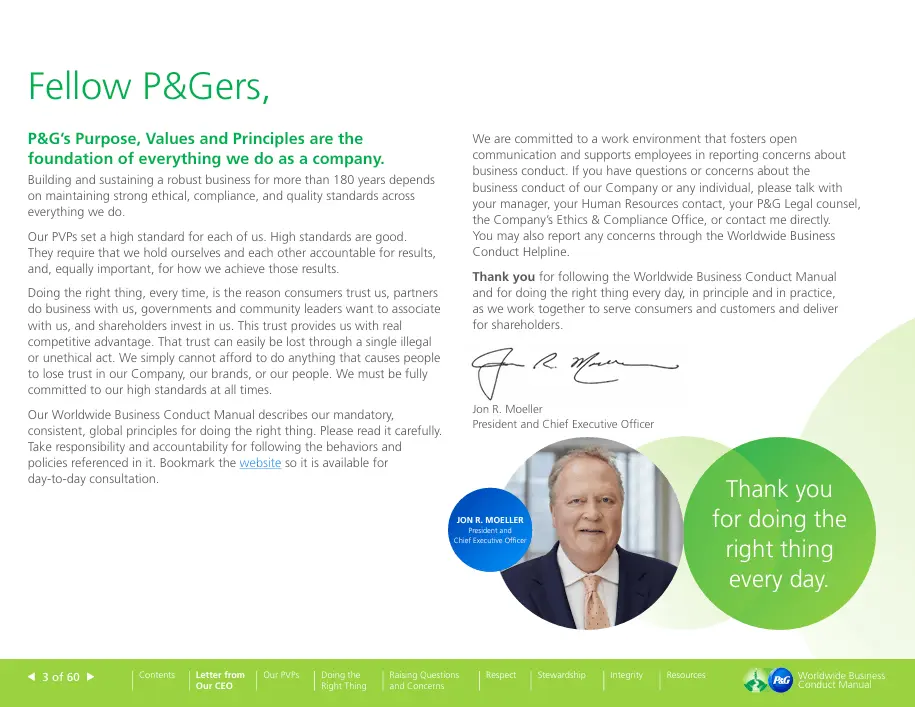
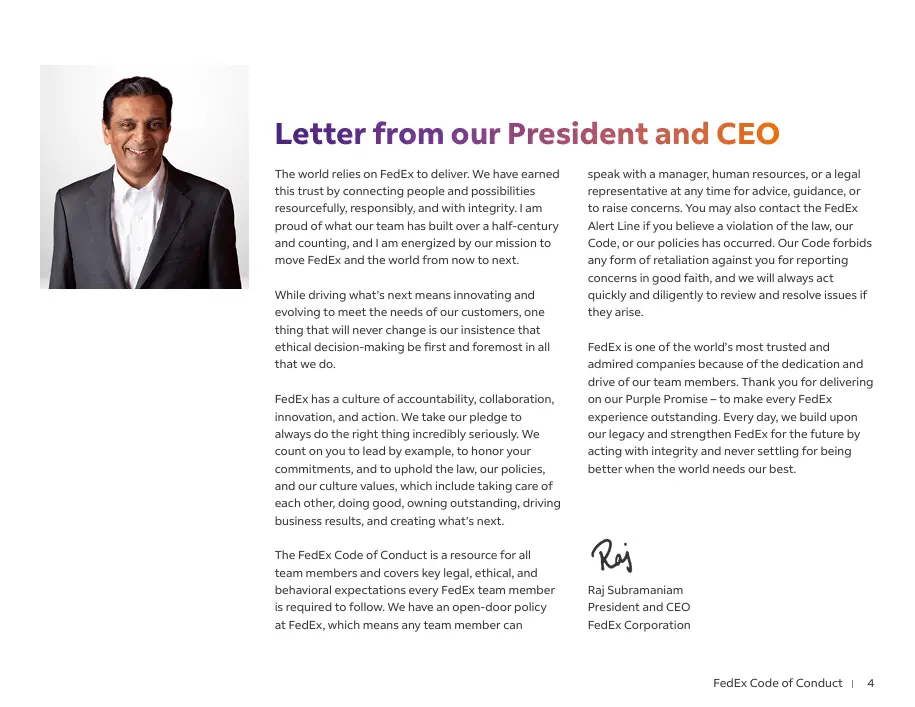
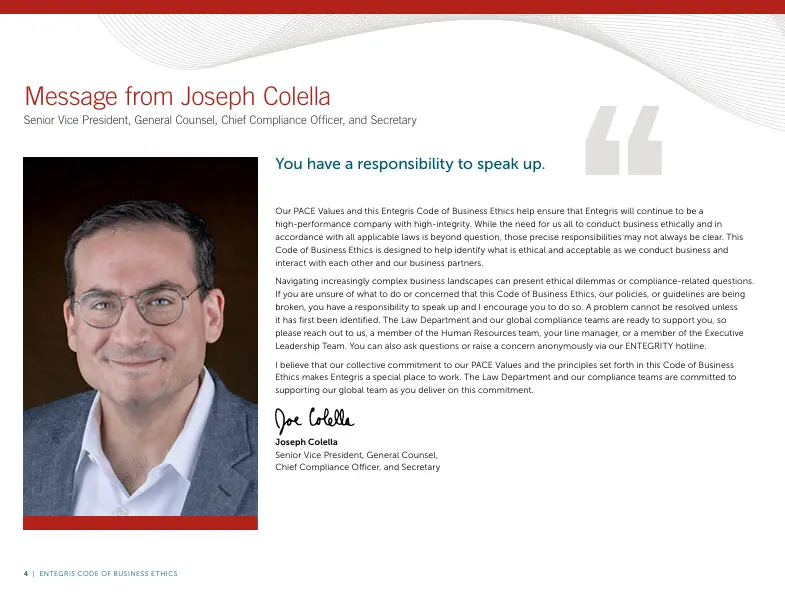
Letter from Leadership
A letter from the Chief Executive Officer or the Chief Compliance Officer effectively sets the tone for the company’s expectations and should stress the importance of ethics, compliance, and integrity, following the Code, and speaking up to ask questions before taking actions and reporting concerns if they arise.
Purpose and Values
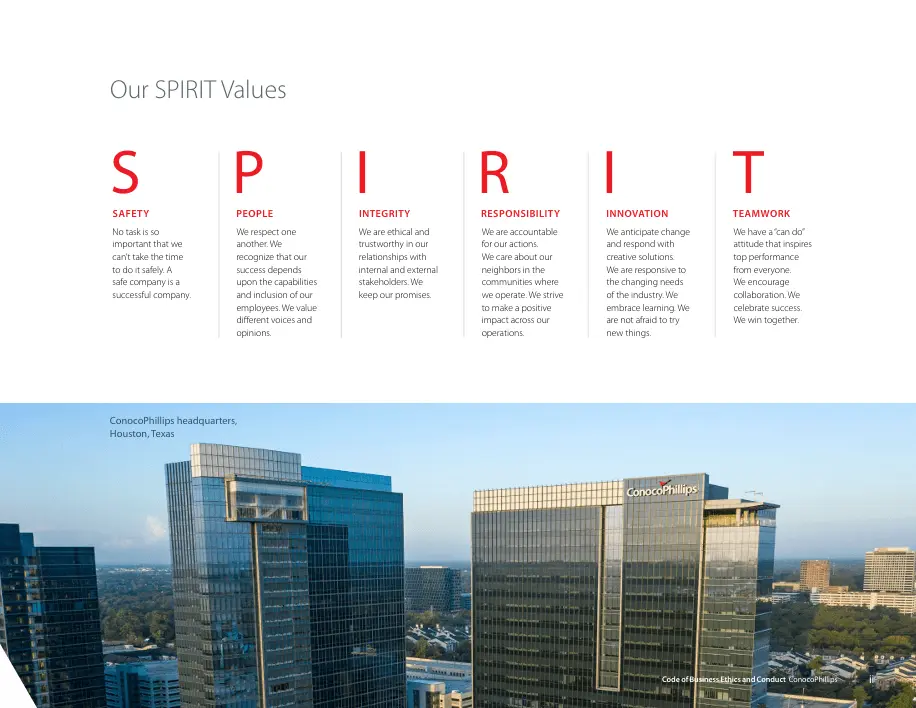
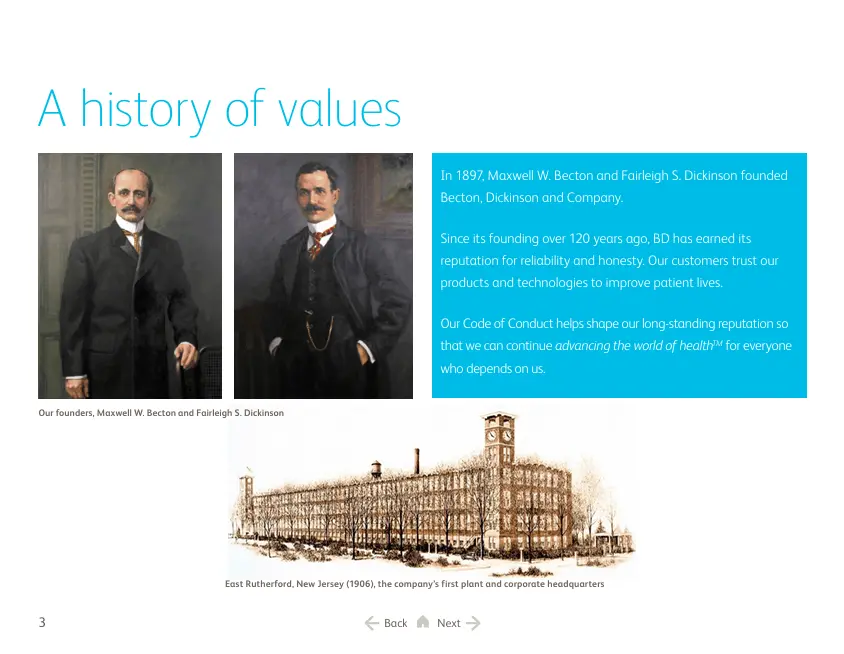
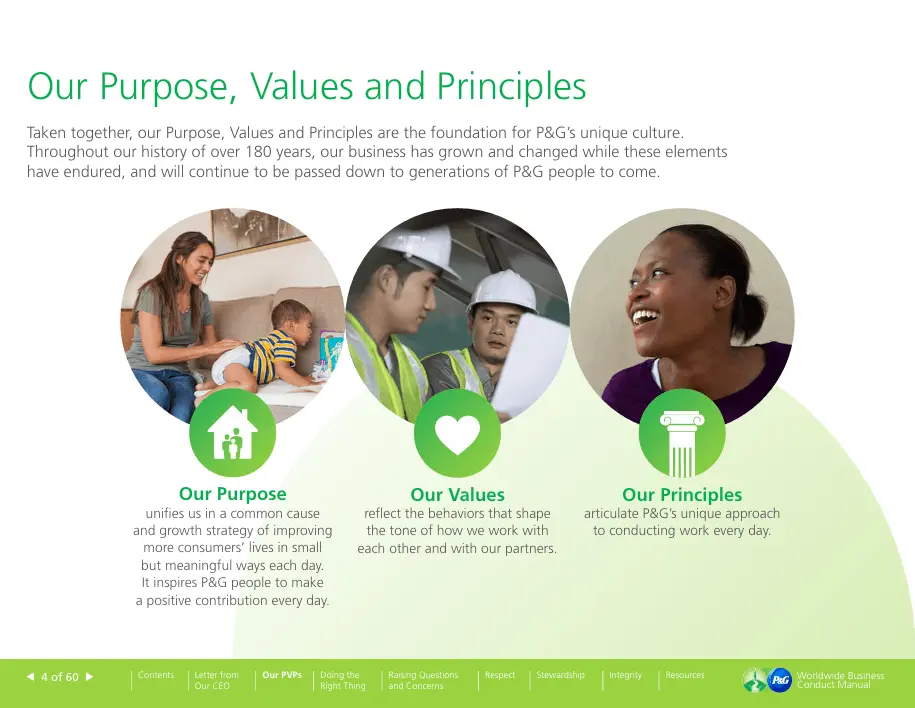
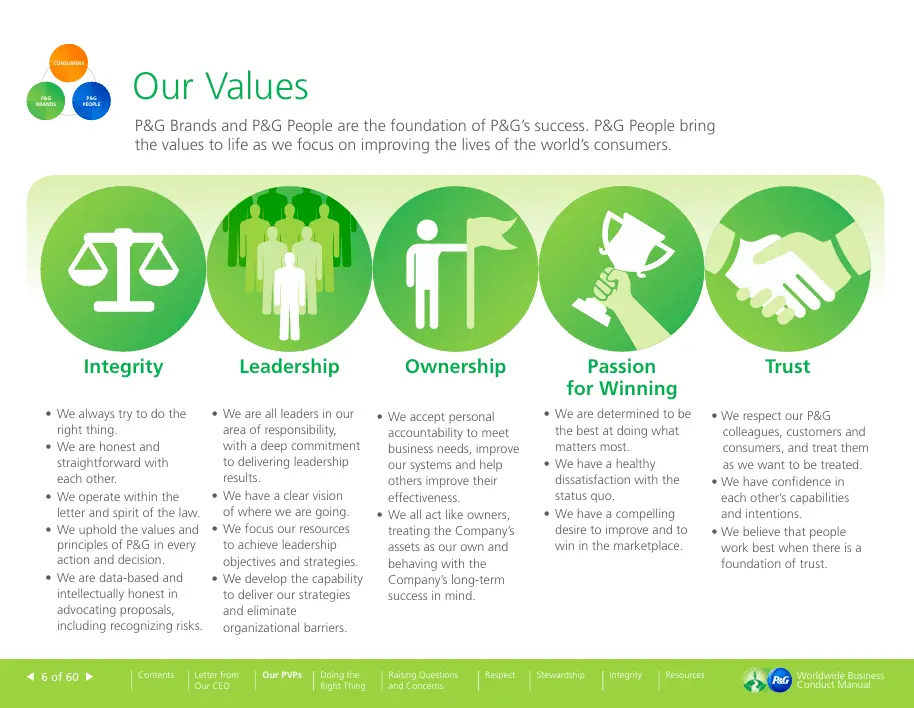
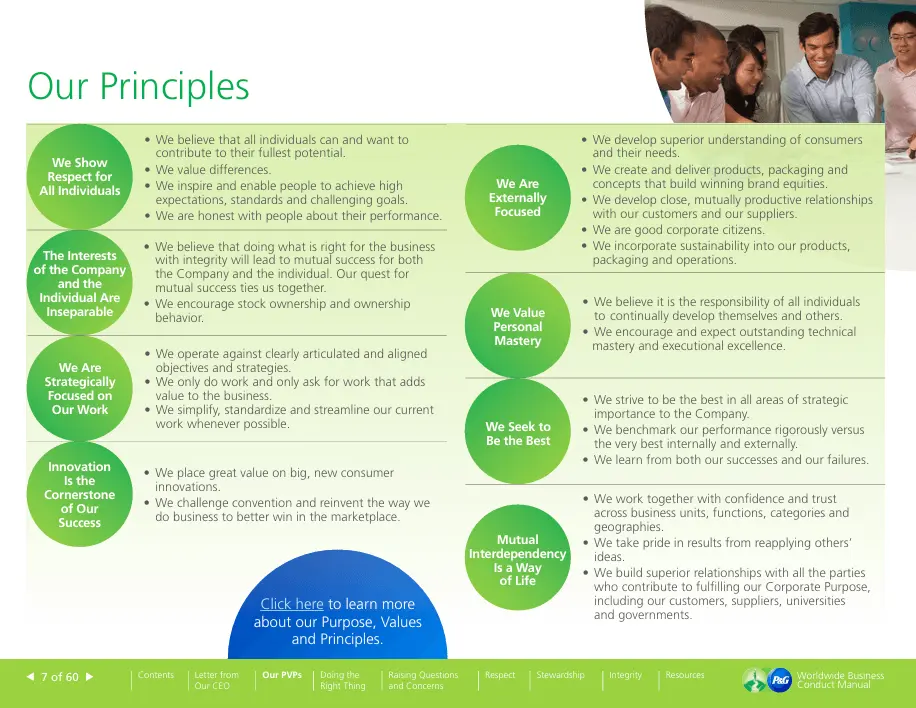
The most effective Codes of Conduct speak to each corporation’s values and how they are upheld through the behaviors of management and employees. Codes that align purpose, values and ethical standards create a compelling message.

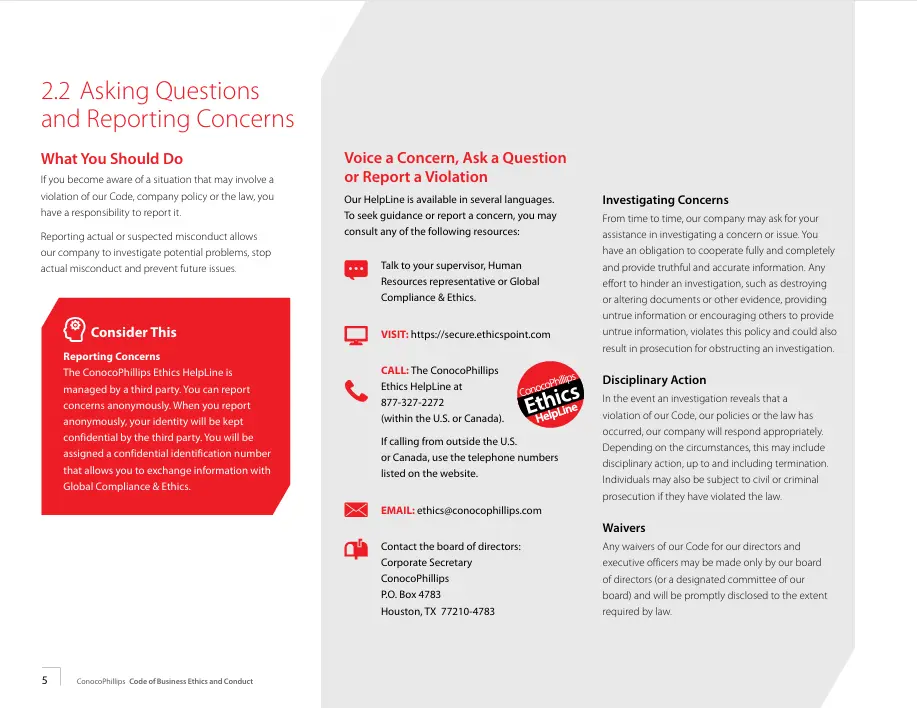
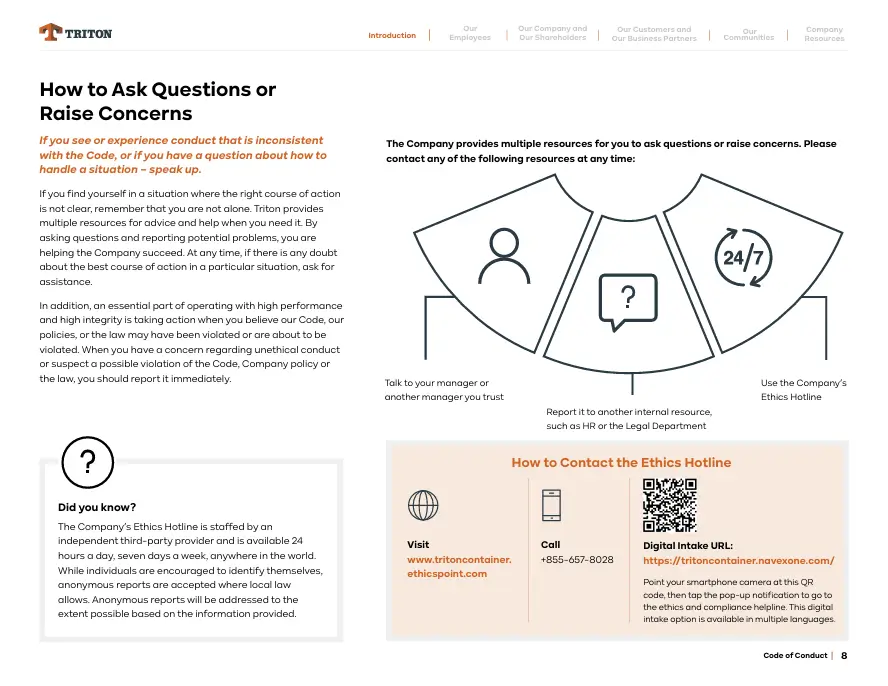
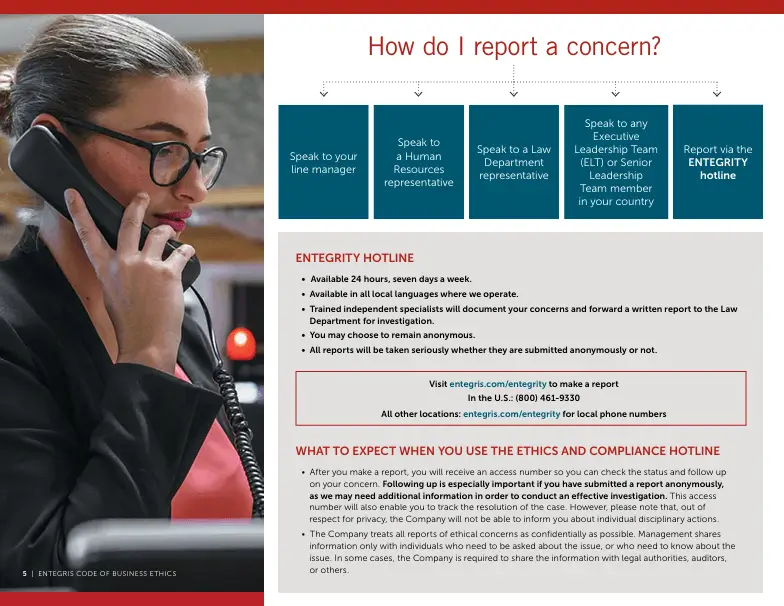
How to Report a Concern
Companies should include a section dedicated to how employees (and others) raise their concerns. Infographics are particularly useful in depicting the reporting procedure.
An Inspired User Experience
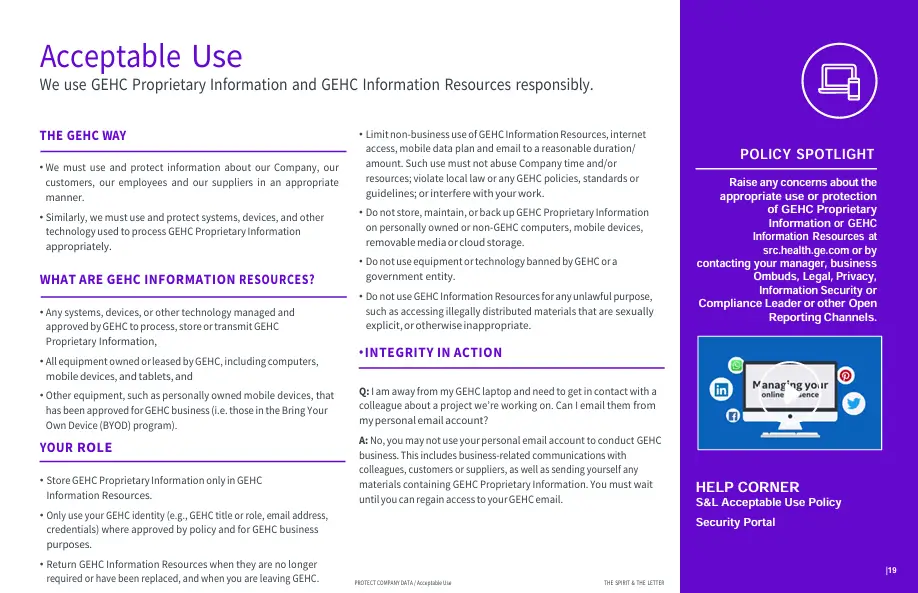
The best Codes of Conduct present strong visuals that align with corporate branding to create a document that feels more like a communications tool than a legal exercise. In the most engaging documents, visual signposts, flowcharts, and graphics are used to further reader understanding. The most effective Codes of Conduct bring reality to hypothetical circumstances and provide a framework for decision-making that is practical and relevant to day-to-day business activities.
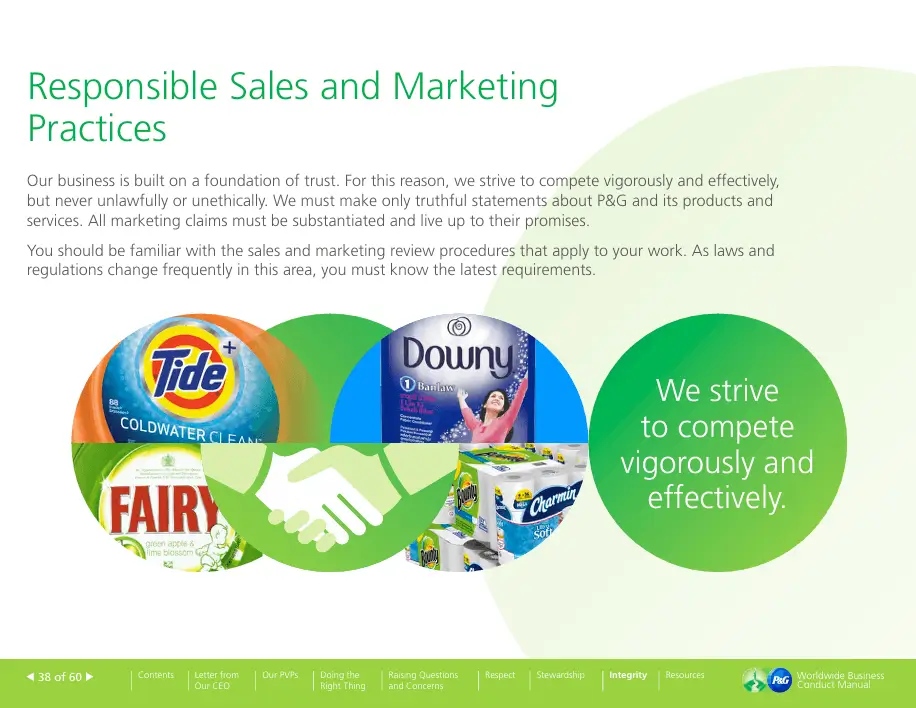
Company Brand
Anchoring the Code of Conduct to the company can be accomplished through integrating the company’s tagline or other messaging from its website, matching other reporting covers, using company imagery throughout, and highlighting company products.



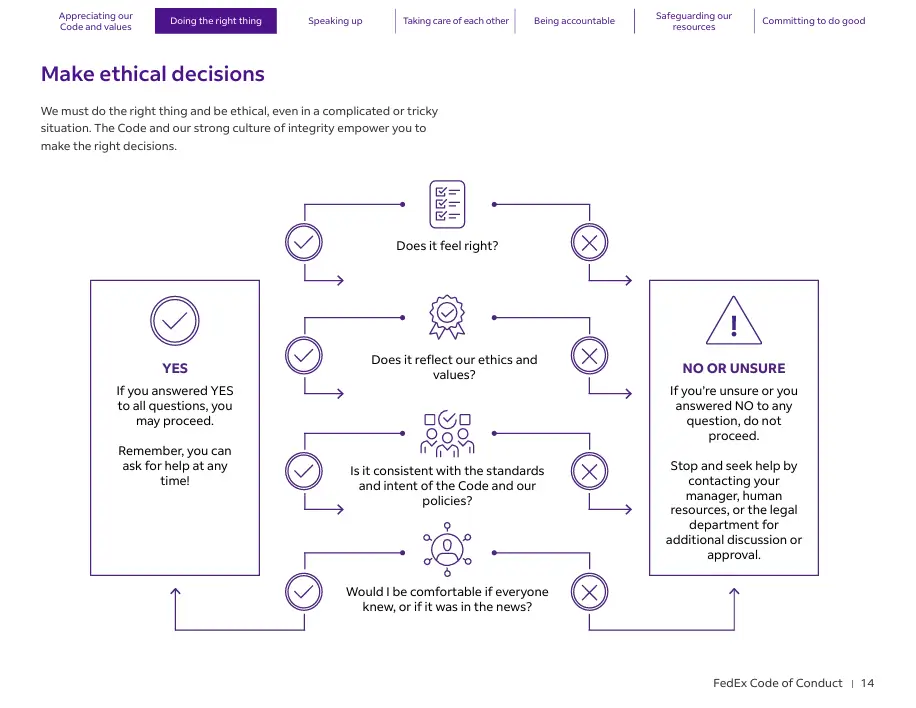
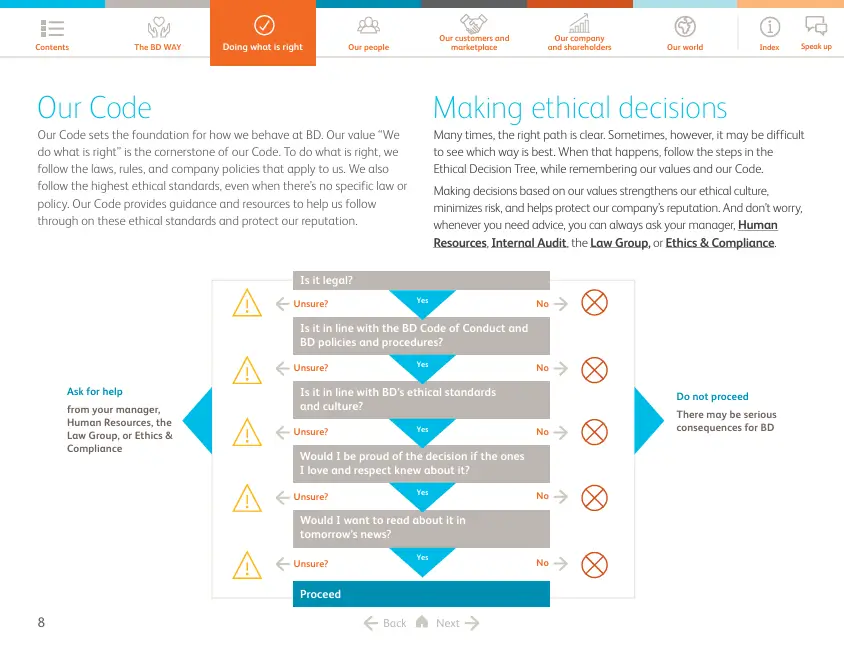
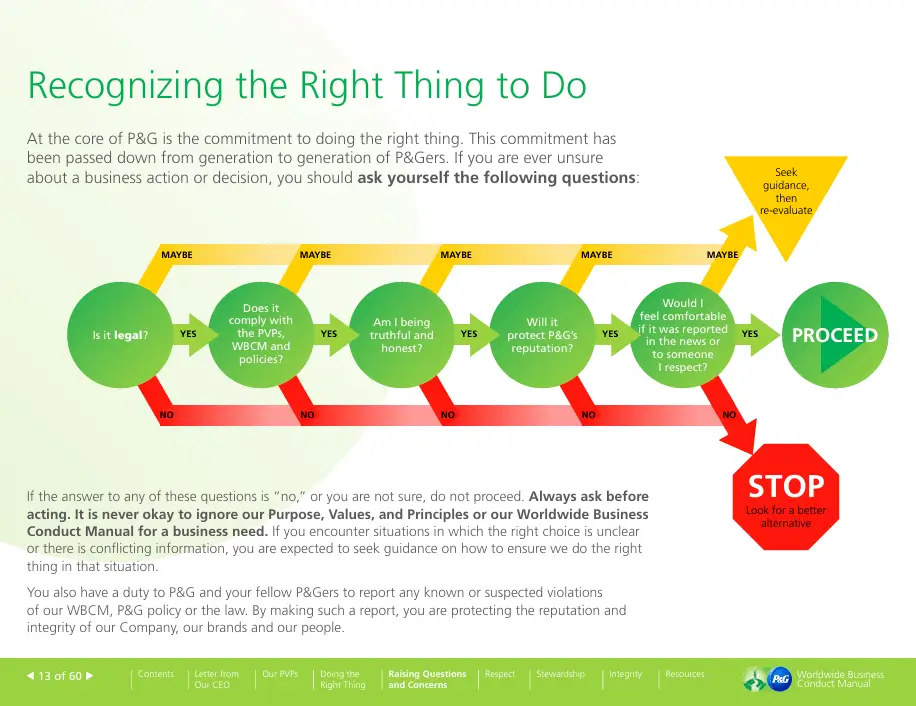
Decision Trees
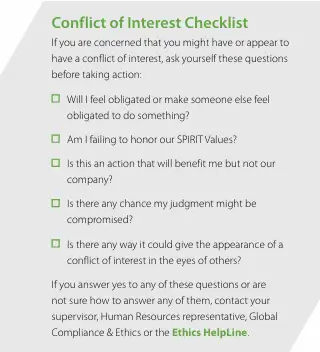
Decision trees are useful in helping frame employee considerations of how to act and when to reach out to others in the organization for assistance in deciding how best to proceed in a given situation.
Case Studies/Q&A
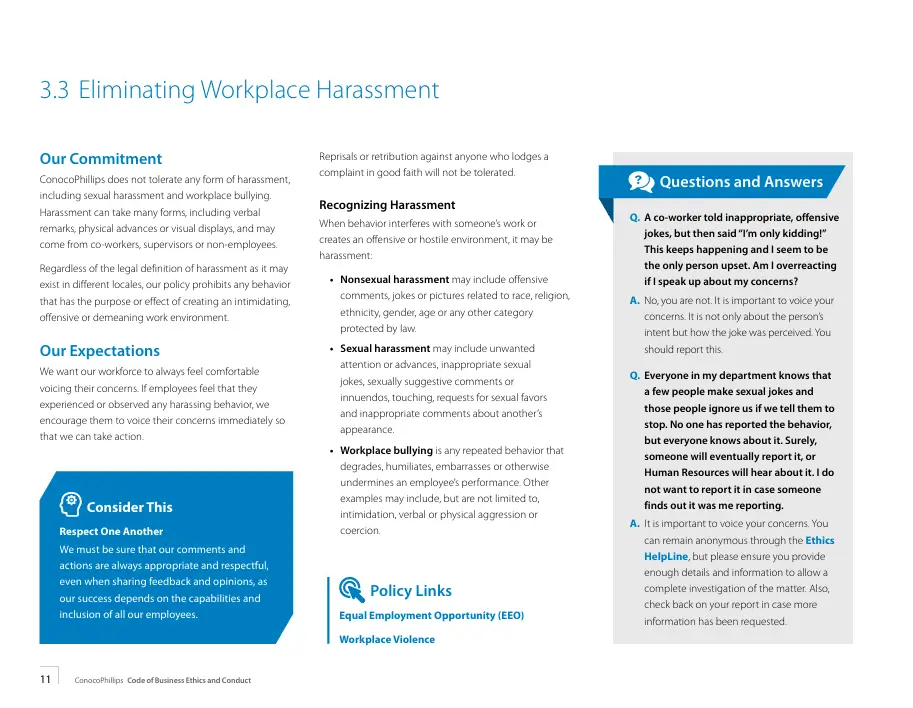
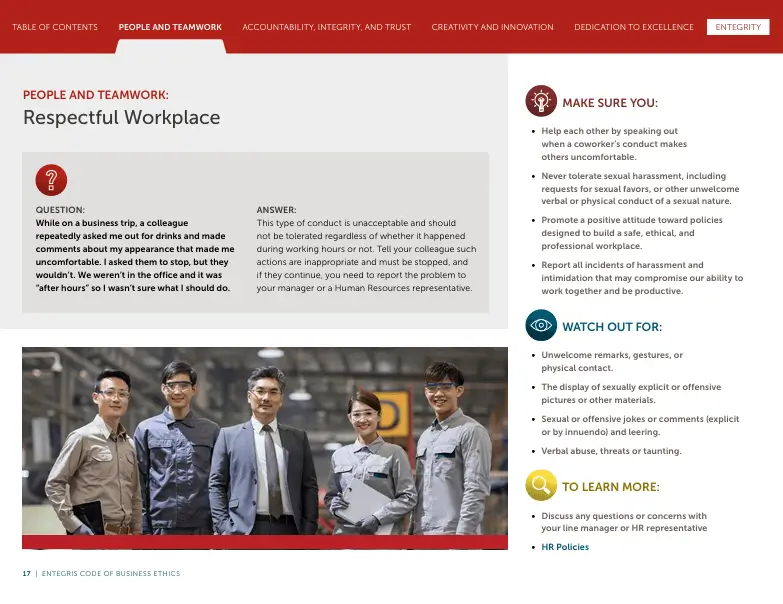
Presenting example case studies with suggestions on how to proceed helps employees understand how the Code of Conduct applies to their everyday work situations and provides them with practical solutions to address concerns that may arise.
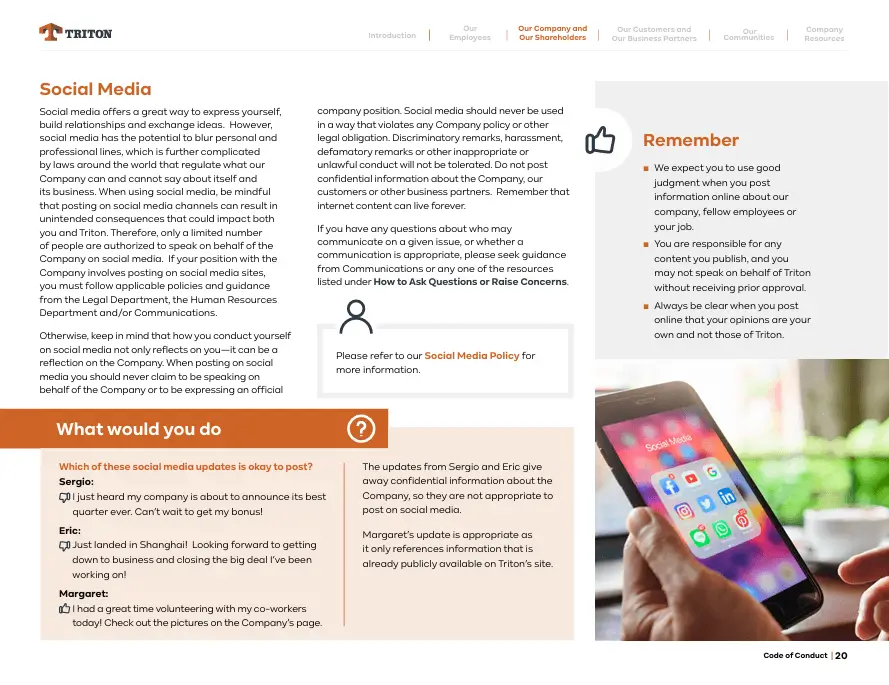
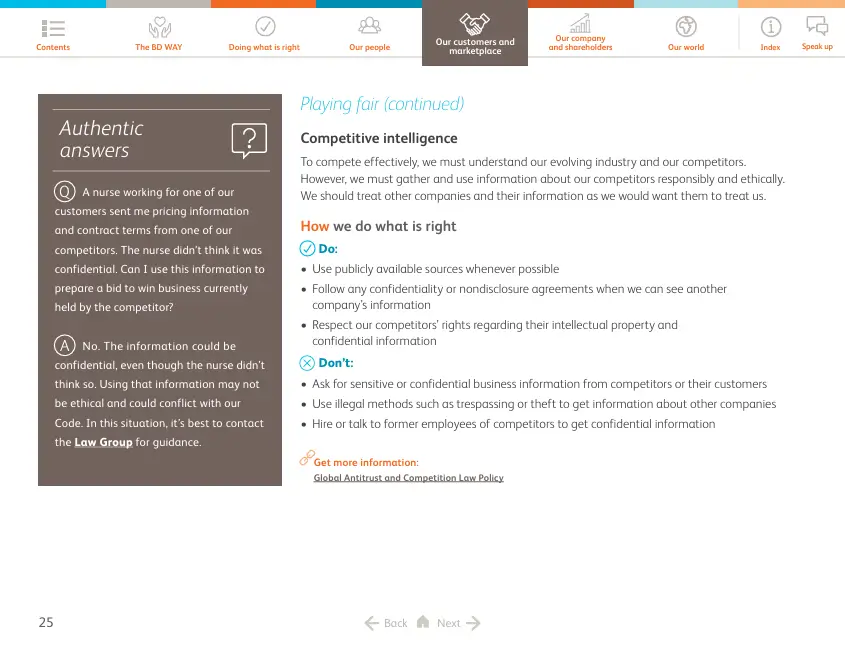
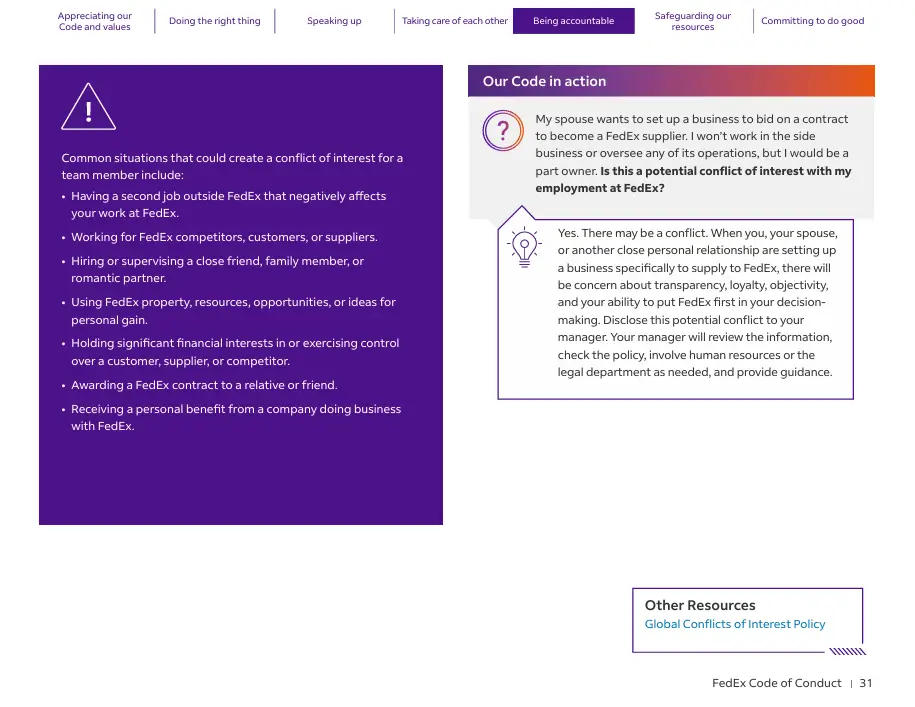
Highlighting related Policies and other Visual Aids
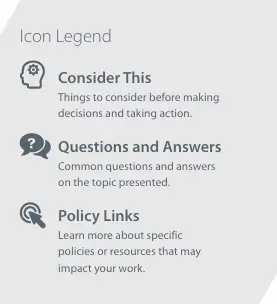
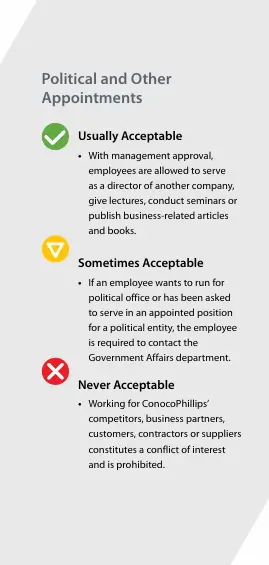
Infographics and visual cues can be used throughout a Code of Conduct to guide readers to additional company information and to present useful takeaways and considerations.